
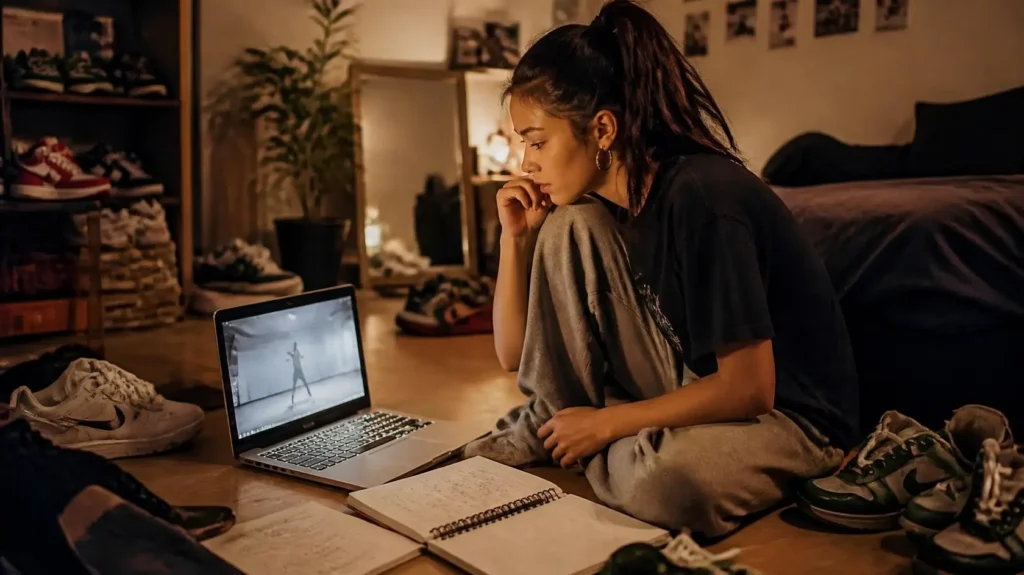
At the start, dance progress is fast. Every week you learn something new and feel yourself getting better. Then, at some point, it slows down. You practice just as hard, but nothing seems to change. Your dance motivation starts slipping, and you wonder if you’ve hit your limit.
You haven’t. Every dancer goes through this. Here’s why it happens and how to keep going.
Why Progress Slows Down
Early improvements are big and obvious because you’re learning basics from scratch. As you get better, improvements become smaller and more subtle: cleaner transitions, better musicality, slightly more control. They’re just as important, but much harder to notice day to day.
Plateaus are also often the moment just before a breakthrough. Your body and brain are consolidating skills in the background. Many dancers quit right before the jump forward.
1. Look at the Long View
Day-to-day progress is hard to see. Month-to-month progress usually isn’t.
Compare a clip from today with one from three or six months ago. Most dancers are surprised by how much has changed. If you don’t have old clips, start filming now. Your future self will thank you.
2. Track Small Wins
Write down small victories: a cleaner turn, a new combo learned, a good freestyle session, a correction finally clicking. Small wins add up, and seeing them listed is a powerful reminder that you are improving.
3. Set Specific, Short-Term Goals
“Get better at dancing” is too vague to feel progress on. Instead, set specific goals for the next two to four weeks:
- Land a clean double turn on both sides.
- Learn and clean one full choreography.
- Freestyle for three songs without repeating the same move.
- Hold a freeze for five seconds.
Hitting short-term goals keeps you moving and gives you something clear to aim at.
4. Change Something
If you’ve been doing the same thing for months, your progress might need a fresh stimulus:
- Take a class in a new style.
- Train with different people.
- Change the music you practice to.
- Focus on a skill you usually avoid.
- Enter a battle or showcase to give yourself a deadline.
Sometimes a small change is enough to restart momentum. See how to stay inspired when you feel stuck in dance.
5. Reconnect With Why You Dance
Motivation often fades when dance becomes only about improvement. Remember why you started: the music, the feeling, the community, the freedom. Spend some sessions dancing purely for fun, with no goals at all.
6. Rely on Routine, Not Motivation
Motivation comes and goes. Routines don’t. Set fixed practice times and keep showing up, even for short sessions. On low-motivation days, a 15-minute session still counts. See how to stay disciplined with dance practice.
7. Rest If You Need It
Sometimes low motivation is a sign of fatigue or overtraining. If you’re constantly tired, sore and flat, a few lighter days may restore your energy. Read why rest and recovery are important for dancers.
8. Stop Comparing
Seeing other dancers progress quickly on social media can make your progress feel even slower. Remember that you’re seeing their highlights, not their plateaus. Read how to stop comparing yourself to other dancers.
Frequently Asked Questions
Why does my dance progress feel so slow?
Early improvements are big and obvious; later ones are smaller and more subtle. Plateaus are normal and often come right before a breakthrough.
How do I stay motivated to dance?
Track small wins, set short-term goals, compare yourself to your past self, change up your training and reconnect with why you love dancing.
What should I do when I’m stuck in a dance plateau?
Try something new: a different style, new music, a new training partner or a goal with a deadline, like a battle or showcase.
Is it normal to lose motivation for dance?
Yes. Every dancer goes through low-motivation periods. Routines and small goals help carry you through.
The Bottom Line
Slow progress doesn’t mean you’re not improving. It usually means your improvements are getting more refined. To keep your dance motivation alive, look at the long view, track small wins, set short-term goals, mix things up, rely on routine and remember why you started. Plateaus end. Dancers who keep going are the ones who break through.
Leave a Reply