

Commanding the stage is about control. Not control of your moves, but control of the space and everyone’s attention within it. Whether it’s a theater stage, a showcase floor or a battle cypher with people pressing in on every side, some dancers step in and instantly make it theirs.
This guide focuses on the practical side: how to use space, timing and attitude to command the stage or the cypher. (For the broader skill set behind presence, see how to improve your stage presence as a dancer.)
Stage vs. Cypher: Different Spaces, Same Principle
On a stage, the audience is in front of you. In a cypher, they’re all around you, close enough to touch. The principle is the same in both: the space is yours for as long as you’re in it. How you claim it depends on the setting.
1. Claim the Space Before You Move
Commanding starts before the first move. How you enter tells everyone what to expect.
- On stage: walk to your starting position with purpose, settle, and pause for a moment before you begin.
- In a cypher: step into the center rather than staying at the edge. Take a beat to feel the music before you go.
That small pause is powerful. It signals that you’re in no hurry, and that you’re in charge.
2. Use the Whole Floor
Dancers who stay in one small spot shrink their presence. Commanding the stage means using all of it.
On stage: plan where you’ll travel. Move between downstage (closest to the audience), center and the corners. Change directions so different parts of the audience see you from different angles.
In a cypher: move around the circle. Face different sections of the crowd. Approach your opponent, then pull back. Make the whole circle feel like it belongs to you.
3. Control Your Focus
Where you look tells people where to look. Strong focus keeps the audience’s attention locked on you.
- Look out and up, not down at the floor.
- Use deliberate focus changes: a sharp look to the crowd, a glance at your opponent, a stare at the judges.
- Hold your gaze longer than feels natural. It reads as confidence.
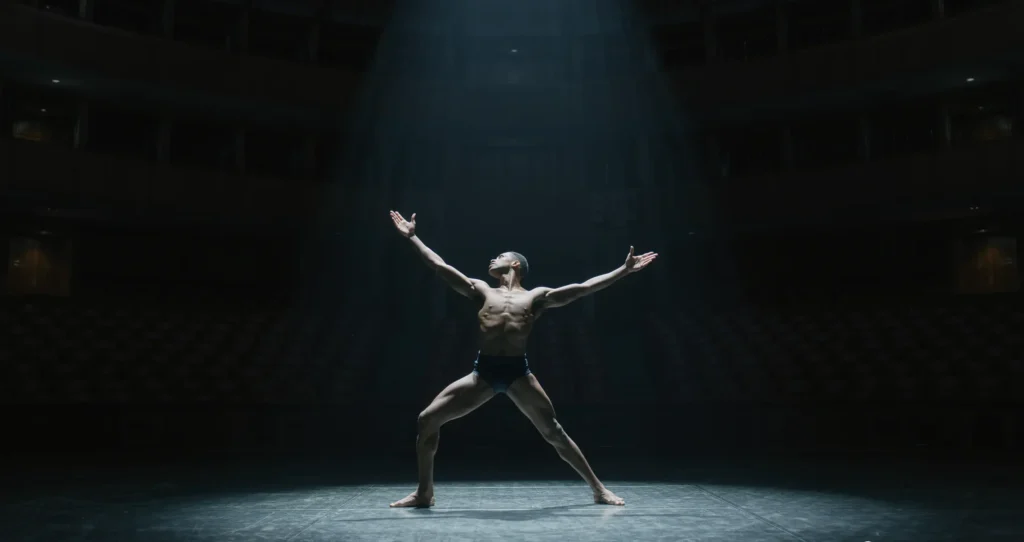
4. Own Your Pauses
Dancers who are afraid of stillness fill every second with movement. Dancers who command the stage use stillness as a weapon. A freeze on a break in the music, a held stare before the next phrase, a moment of calm before an explosive move: these grab attention more than constant motion.
5. Bring Attitude
Commanding the stage requires a mindset: this is my space right now. Not arrogance, but certainty. Let that show in your posture, your face and the way you move between steps.
In battles, attitude is part of the conversation. Responding to your opponent’s round, reacting to the music or playing to the crowd all show that you’re in control of the moment.
6. Finish Your Time Cleanly
Commanding the stage includes how you leave it. End with a clear, deliberate final moment and hold it. In a cypher, exit with confidence. Don’t just drift out of the circle. A strong ending reinforces everything you did before it.
Stage Command Checklist
| Moment | Action |
|---|---|
| Entrance | Walk in with purpose and pause before starting |
| Space | Travel and face different parts of the audience |
| Focus | Eyes up, deliberate looks, hold your gaze |
| Stillness | Use pauses and freezes on purpose |
| Attitude | Move like the space is yours |
| Exit | End clean and hold your final moment |
Frequently Asked Questions
How do I command the stage as a dancer?
Claim the space with a confident entrance, use the whole floor, control your focus, use stillness deliberately, bring attitude and finish with a strong ending.
How do I own the cypher in a dance battle?
Step into the center, move around the circle, engage different parts of the crowd and your opponent, react to the music and exit with confidence.
What’s the difference between stage presence and commanding the stage?
Stage presence is your overall ability to hold attention. Commanding the stage is the practical side: how you use space, focus and timing to take control of it.
What if I’m on a small stage?
Focus on levels, direction changes, strong focus and stillness. These help you command even a small space.
The Bottom Line
To command the stage, claim your space before you start, use every part of it, direct the audience’s attention with your focus and own your pauses. Bring certainty to everything you do, and end with a strong, deliberate moment. Whether it’s a stage or a cypher, for those moments, the floor belongs to you.
Leave a Reply