
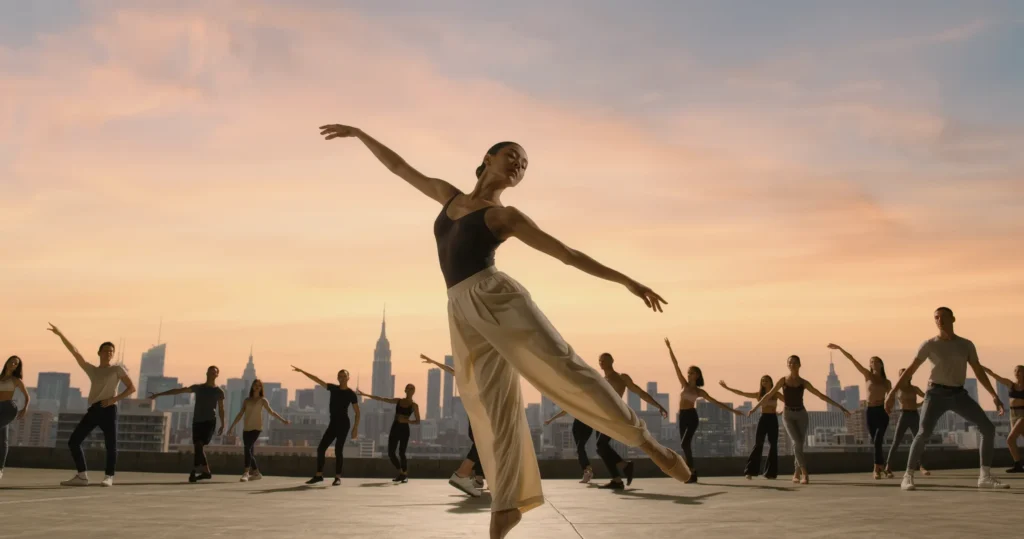
Turns are one of the most satisfying things to land and one of the most frustrating to learn. You fall out early, travel across the floor, get dizzy or finish with a wobble that ruins the moment. If you want to know how to improve pirouettes and single-leg turns, the fix is rarely “just try harder.” It’s usually one of four things: your spot, your prep, your core or your balance on the standing leg.
This guide breaks each one down, with drills you can practice at home.
Why Turns Go Wrong
Most failed turns come down to a few causes:
- No clear spot, so you lose orientation and get dizzy.
- A weak or rushed preparation, so the turn starts off-balance.
- A soft core, so your upper body twists separately from your hips.
- Weight not fully over the standing leg, so you tip out.
- Too much force, which throws you off your axis.
The rest of this guide tackles each one.
1. Master Your Spot
Spotting is the single biggest improvement you can make. It means fixing your eyes on one point, keeping them there as long as possible while your body turns, then whipping your head around to find the same point again.
Spotting does two things: it reduces dizziness, and it keeps your turn on one straight axis instead of drifting.
Drill: walking spot. Pick a point on the wall at eye level. Slowly walk in a small circle on the spot, keeping your eyes on that point until your head can’t turn any further, then snap your head around to find it again. Do 10 slow turns each direction. Then try it with quick half turns on both feet before moving to single-leg turns.
2. Build a Solid Preparation
A clean turn starts before you leave the floor. In ballet, the classic preparation is from fourth position: feet apart, front knee bent, weight centered between both feet, arms ready.
Whatever style you’re in, your prep needs:
- Weight centered so you’re not falling forward or back.
- A controlled plié (knee bend) to create push.
- Arms set so they can close in and help you rotate.
Rushing the prep is one of the most common reasons turns fail. Take your time.
3. Find Your Axis: Weight Over the Standing Leg
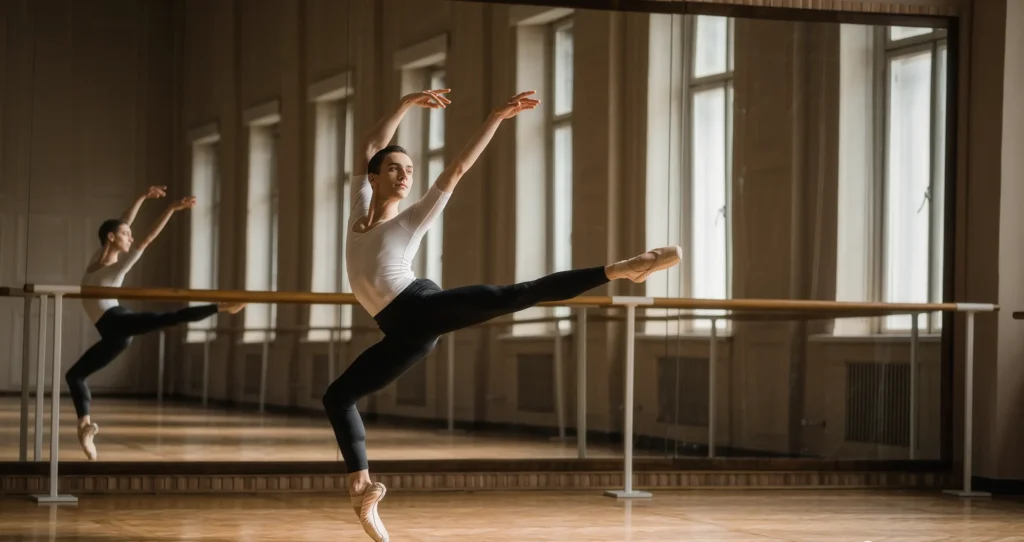
In a single-leg turn, your whole body needs to stack over the ball of your standing foot. If your hips sit back or your chest leans forward, you’ll tip out.
Drill: relevé balance. Stand on one leg in your turning position (the working foot at the side of the knee, often called passé or retiré). Rise onto the ball of your standing foot and hold for 5 to 10 seconds. If you can’t hold it still, you won’t be able to turn in it cleanly. Build that balance first. Our guide on how to improve your balance for better dancing has more exercises.
4. Engage Your Core
When your core is loose, your shoulders turn before your hips, and your body twists like a wet towel instead of rotating as one unit.
Before turning, lightly brace your core and imagine your torso as a solid cylinder. Keep your ribs closed rather than flared. Regular core work makes this automatic; see the best core exercises for dancers.
5. Use Less Force Than You Think
Beginners often try to power through turns by throwing their arms. Too much force pushes you off your axis. A clean single turn needs surprisingly little push when your alignment is right.
Start with smooth single turns. Once they’re consistent, add force gradually for doubles. The goal is control first, then speed.
6. Finish the Turn
A turn isn’t done when the rotation ends. It’s done when you land cleanly and hold. Practice finishing every turn in a controlled position for a full count. In battles and performances, a controlled finish is what makes a turn look impressive, not just the number of rotations.
A Simple Turn Practice Routine
| Step | Drill | Reps |
|---|---|---|
| 1 | Walking spot, both directions | 10 each way |
| 2 | Relevé balance in turning position | 3 x 10 seconds each leg |
| 3 | Quarter turns, then half turns | 8 each side |
| 4 | Single turns with a held finish | 8 each side |
| 5 | Doubles (only when singles are clean) | 5 each side |
Always practice both directions. Most dancers have a stronger side, and training only that side makes the gap bigger.
Common Turning Mistakes
- Looking down instead of spotting at eye level.
- Leaning back or forward on the standing leg.
- Throwing the arms too hard.
- Letting the working leg drop mid-turn.
- Rushing the landing.
Frequently Asked Questions
How do I stop getting dizzy when I turn?
Spot. Keep your eyes fixed on one point for as long as possible, then quickly bring your head around to the same point. With practice, dizziness drops significantly.
Why do I fall out of my pirouettes?
Usually your weight isn’t fully over your standing foot, your core is loose, or your preparation is rushed. Fix balance on relevé first.
How can I turn more times?
Get your single turns clean and consistent first. Extra rotations come from better alignment and a strong spot, not more force.
Do I need ballet training to do good turns?
No, but ballet fundamentals like spotting, relevé and alignment help turns in every style, from contemporary to hip-hop.
The Bottom Line
To improve pirouettes and single-leg turns, fix the fundamentals: spot sharply, prepare with control, stack your weight over your standing leg and keep your core engaged. Use less force than you think and always finish cleanly. Get your singles solid and the doubles will follow.
Leave a Reply