
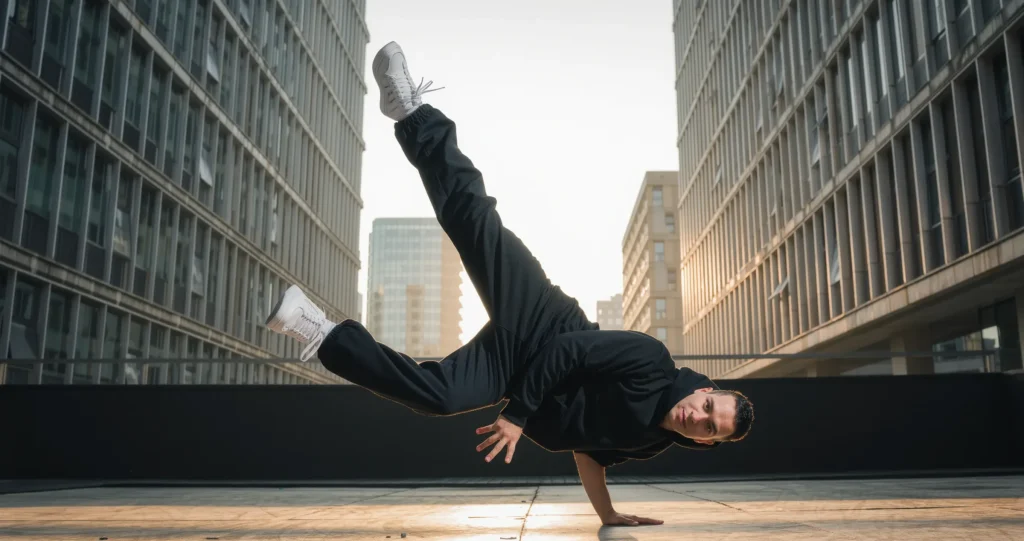
Balance is the skill nobody notices until it’s missing. A wobble at the end of a turn, a freeze that tips over, a landing that stumbles: these are the moments that make an otherwise strong performance look unfinished. If you want to improve balance for dance, the answer isn’t just “stand on one leg more.” It’s training the systems your body uses to stay stable.
Here’s how dancers build balance that holds up under speed, pressure and music.
Why Balance Matters in Every Dance Style
Balance shows up everywhere. In ballet and contemporary it’s obvious: turns, extensions, relevés. But it matters just as much in street styles. Breaking freezes, popping hits, sudden stops in a battle round and one-leg footwork all depend on it.
Good balance also makes you look relaxed. When you’re stable, you don’t need to tense up to stay upright, so your movement looks smoother and more confident.
What Actually Controls Your Balance
Your body balances using three systems working together:
- Your feet and ankles, which constantly adjust to tiny shifts in weight.
- Your core, which keeps your torso stacked over your base.
- Your eyes and inner ear, which tell your brain where you are in space.
Train all three and your balance improves quickly. Train only one and progress stalls.
1. Strengthen Your Feet and Ankles
Most balance problems start at the ground. Weak feet can’t make the small corrections needed to keep you steady.
Exercises:
- Slow calf raises: rise onto the balls of your feet for 3 seconds, lower for 3 seconds. 3 sets of 12.
- Single-leg calf raises: the same movement on one leg, holding a wall lightly at first.
- Towel scrunches: sit with a towel under your foot and pull it towards you using only your toes.
2. Build a Stable Core
When your core is weak, your upper body sways and your legs have to fight to keep up. A strong core keeps everything stacked so balance becomes easier.
Planks, dead bugs and side planks are a great starting point. We break down a full routine in the best core exercises for dancers.
3. Practice Single-Leg Balance, Then Make It Harder
Start simple and progress in stages. Only move to the next stage when you can hold the current one for 30 seconds on each leg without wobbling.
| Stage | Exercise |
|---|---|
| 1 | Stand on one leg, knee soft, arms relaxed |
| 2 | Same, with your eyes closed |
| 3 | Rise onto the ball of your standing foot |
| 4 | Stand on a cushion or folded mat |
| 5 | Add slow arm or head movements |
Closing your eyes is the big one. It removes your visual reference and forces your feet and core to do the work.

4. Use a Focus Point
Your eyes play a huge role in balance. When your gaze drifts, your body follows.
Pick a fixed point at eye level whenever you hold a balance. In turns, this becomes spotting: keeping your eyes on one point as long as possible, then whipping your head round to find it again. It’s the single biggest fix for dizzy, wobbly turns. Learn more in how to improve your pirouettes and single-leg turns.
5. Train Balance Inside Movement
Standing still on one leg is useful, but dancing is never still. The real test is balance during and after movement.
Drills:
- Move and freeze: freestyle for 8 counts, then freeze on one leg for 4 counts. Repeat through a whole song.
- Hop and stick: hop forward on one foot and land without any extra wobble. Hold for 2 seconds.
- Turn and hold: do a simple single turn and hold the finishing position for 3 seconds.
These drills are where balance starts to show up in your actual dancing, especially in battles, where clean stops make your rounds look sharp and intentional.
6. Fix Your Alignment
If your hips are tilted or your ribs are flared, your center of gravity shifts and balance gets harder. Stack your head over your ribs, your ribs over your hips, and your hips over your standing foot.
A quick check: when balancing on one leg, you should be able to draw a straight vertical line from your ear down to your ankle. Our guide on how to fix your dance posture goes deeper.

Common Balance Mistakes
- Locking the standing knee instead of keeping it soft.
- Gripping the floor with clenched toes.
- Holding your breath.
- Letting your eyes wander.
- Only practicing on your stronger leg.
Frequently Asked Questions
How can I improve my balance for dance quickly?
Practice single-leg balance daily, including with eyes closed, strengthen your ankles and core, and always use a focus point. Most dancers notice a difference within two to three weeks.
Why do I lose balance when I turn?
Usually it’s poor spotting, a weak core, or your weight not being fully over your supporting foot. Fixing your spot alone makes a big difference.
Is balance something you’re born with?
Some people start with better balance, but it’s highly trainable. Consistent practice improves it at any age or level.
How often should dancers train balance?
A few minutes every day works better than one long session a week. Balance drills fit easily into a warm-up.
The Bottom Line
To improve balance for dance, train the full system: strong feet and ankles, a stable core, a steady focus point and good alignment. Then practice balance inside real movement, not just standing still. A few minutes a day is enough to turn wobbly finishes into clean, controlled moments that make your whole performance look stronger.
Leave a Reply