
You’re in class, the teacher runs the routine once at full speed, and suddenly everyone else seems to know it while you’re still stuck on the first eight. Sound familiar? Learning to pick up choreography quickly is a skill of its own, separate from how well you dance. The good news is it can be trained.
Here’s how to learn choreography fast, remember it longer and stop getting lost halfway through.
Why Choreography Feels Hard to Learn
When a routine moves fast, your brain is trying to process steps, direction, arms, counts and style all at once. It’s too much information in too little time, so something falls out.
The dancers who pick up choreo quickly aren’t necessarily more talented. They’ve built a system for breaking information down. Here’s that system.
1. Learn the Counts, Not Just the Moves
Almost all choreography is built on counts of eight. When you attach every move to a number, you give your brain a structure to hang it on.
Instead of thinking “slide, then turn, then drop,” think “slide on 1, turn on 3, drop on 5-6.” Say the counts out loud or under your breath while you learn. If you’re unsure how to count music, start with our guide on why musical timing matters for every dancer.
2. Chunk It Into Small Pieces
Don’t try to remember a whole routine. Remember one eight at a time, then link them.
- Learn the first eight until it’s solid.
- Learn the second eight.
- Run the first and second together.
- Add the third, and run all three.
This “add and repeat” method is slower at the start, but you’ll remember the routine far longer than if you try to absorb it all at once.
3. Learn Feet First, Then Arms, Then Style
Trying to get every detail on the first run is how you get lost. Layer it instead:
- Layer 1: footwork and direction. Where are you going?
- Layer 2: arms and upper body.
- Layer 3: style, texture, facials and dynamics.
Once your feet are right, the rest usually falls into place, because the arms are anchored to the steps.
4. Give Moves Names
Your brain remembers words and pictures better than abstract movements. Give each move a quick nickname: “the wipe,” “the stomp-drop,” “the lean.” Then the routine becomes a short list of names you can run through in your head: “wipe, wipe, stomp-drop, lean, spin.”
Many dancers use sounds too, singing the rhythm of the moves (“ba-da-BOOM, tss”). Use whatever sticks.
5. Watch the Teacher’s Weight, Not Just Their Limbs
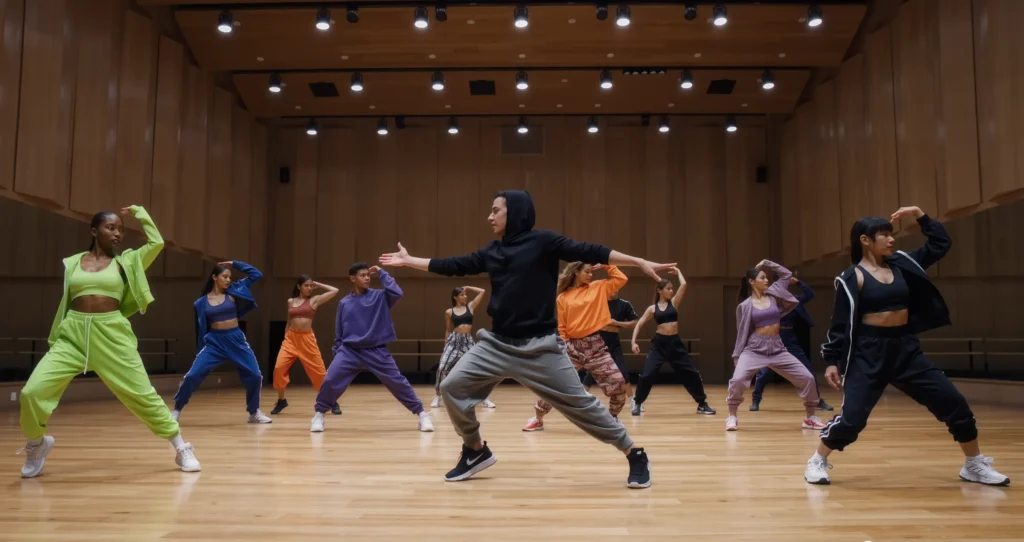
When you watch someone demonstrate, focus on which foot their weight is on and which direction they’re facing. These two details decide whether you end up on the right foot for the next move. Get them wrong and you’ll be scrambling for the rest of the routine.
6. Mark It, Then Dance It Full Out
Marking means doing a small, low-energy version of the choreography to remember the sequence. It’s useful for learning, but don’t only mark. Your body needs to feel the real size and speed of the moves to truly remember them.
Mark while learning, then dance it full out as soon as you know the order.
7. Film It and Review It Straight Away
If you’re allowed, film the teacher’s demonstration or yourself at the end of class. Watch it again that same day, then again the next morning. Reviewing within 24 hours dramatically improves how much you remember.
You can also rehearse mentally: close your eyes, play the music and “run” the choreography in your head. It sounds strange, but visualization is a real memory tool used by dancers and athletes.
8. Build Your Move Vocabulary
The more foundational moves you know, the faster you learn new choreography, because you’ll recognize pieces instead of learning everything from scratch. Taking classes in different styles and practicing freestyle both grow your vocabulary.
Common Mistakes When Learning Choreography
- Trying to learn everything in one go.
- Ignoring counts and relying on “feel.”
- Copying arms before knowing the footwork.
- Only marking and never dancing full out.
- Not reviewing the routine after class.
Frequently Asked Questions
How do dancers learn choreography so fast?
They count the music, break routines into eights, learn in layers (feet, then arms, then style), and have a big vocabulary of moves they recognize instantly.
How can I remember choreography better?
Chunk it, name the moves, count out loud, and review it within 24 hours using video or mental rehearsal.
What should I do if I get lost during a routine?
Keep moving and find the next count of 1. Most choreography resets on the start of an eight, so rejoin there instead of freezing.
Does learning choreography get easier?
Yes. The more routines you learn, the faster your brain gets at breaking them down. It’s a skill that improves with practice.
The Bottom Line
To learn choreography fast, stop trying to absorb everything at once. Count the music, chunk the routine into eights, learn in layers, name your moves and review within a day. With a clear system, even fast choreography becomes manageable, and you’ll spend less time lost and more time actually dancing.
Leave a Reply